
| Pasteurellosis in German Lop rabbit - short communication - DVM Costin Stoica |
A Gram-negative, non-motile coccobacillus was isolated
from the lungs, heart and liver of a dead German Lop rabbit.
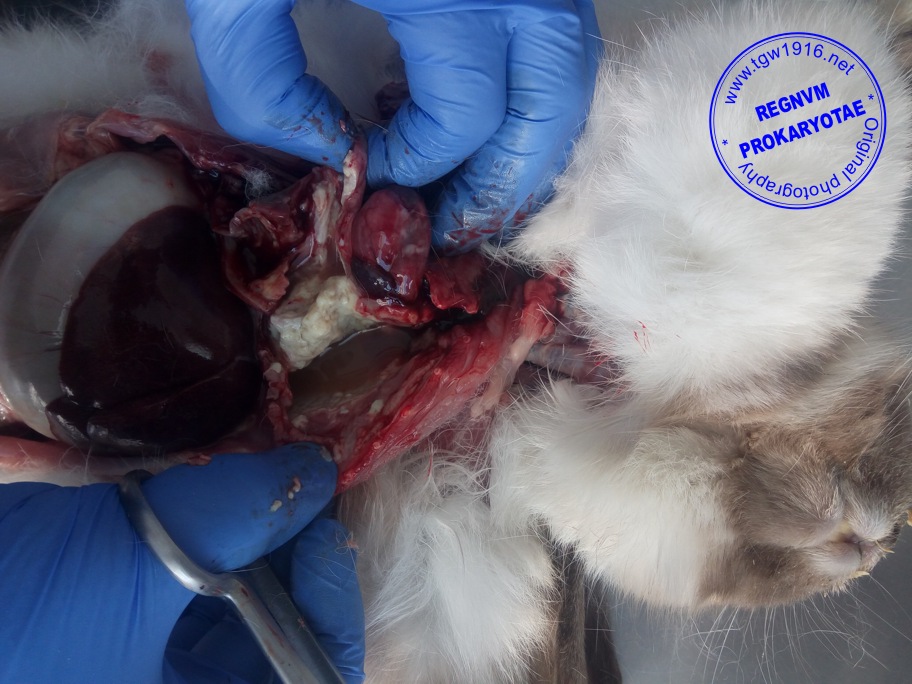
Necropsy show pleuritis, thoracic adhesions with fibrin
deposits, purulent pneumonia, blood collection in trachea,
nasal discharges and spotted liver.
The parasitological examination was negative.
The bacteriological examination found Pasteurella
multocida subsp. septica from heart, lungs and liver and
was negative from kidney and bone marrow.
Morphological and biochemical properties:
After 24h incubation on sheep blood agar, colonies were
2-3 mm in diameter, white-gray and non-hemolytic. No
growth on MacConkey agar, Mueller-Hinton agar and
Simmons citrate agar. Weak growth on TSI agar. Aerobic,
facultatively anaerobic.
Using API 20 NE strips (bioMerieux) the strain was
identified as Pasteurella multocida 96%.
Investigation was extended for more biochemical
characters using API 20 E, API Staph, API Strep strips and
MIU multitest medium.
Based on ABIS online software the strain was identified as
Pasteurella multocida subsp. septica 93%.
from the lungs, heart and liver of a dead German Lop rabbit.
Necropsy show pleuritis, thoracic adhesions with fibrin
deposits, purulent pneumonia, blood collection in trachea,
nasal discharges and spotted liver.
The parasitological examination was negative.
The bacteriological examination found Pasteurella
multocida subsp. septica from heart, lungs and liver and
was negative from kidney and bone marrow.
Morphological and biochemical properties:
After 24h incubation on sheep blood agar, colonies were
2-3 mm in diameter, white-gray and non-hemolytic. No
growth on MacConkey agar, Mueller-Hinton agar and
Simmons citrate agar. Weak growth on TSI agar. Aerobic,
facultatively anaerobic.
Using API 20 NE strips (bioMerieux) the strain was
identified as Pasteurella multocida 96%.
Investigation was extended for more biochemical
characters using API 20 E, API Staph, API Strep strips and
MIU multitest medium.
Based on ABIS online software the strain was identified as
Pasteurella multocida subsp. septica 93%.
Positive results were obtained for alkaline phosphatase,
catalase, indole production (positive in MIU medium and
weak in API 20 NE), nitrates reduction, leucine
aminopeptidase and oxidase (negative in first 24h and
positive later).
Acid was produced from fructose, glucose (positive in API
Staph, weak in API 20 E and negative in API 20 NE),
mannose, mannitol, N-acetyl-glucosamine, saccharose
and xylose.
catalase, indole production (positive in MIU medium and
weak in API 20 NE), nitrates reduction, leucine
aminopeptidase and oxidase (negative in first 24h and
positive later).
Acid was produced from fructose, glucose (positive in API
Staph, weak in API 20 E and negative in API 20 NE),
mannose, mannitol, N-acetyl-glucosamine, saccharose
and xylose.
| Antibiogram |
| Encyclopedia |
| Culture media |

| Biochemical tests |
| Stainings |
| Images |
| Movies |
| Articles |
| Identification |
| Software |
(c) Costin Stoica
| R E G N U M PROKARYOTAE |

| Lungs fibrin block and pleuritis. |
| Pasteurella multocida subsp. septica colonies on Sheep Blood Agar. |
Pasteurelosis is an enzootic or epizootic disease in rabbits. It is also known as the "rabbit hemorrhagic
septicemia". The disease can produce fever, loss of appetite, dispnea, rhinitis, pleuritis, bronchopneumonia,
necrosis spots on liver, hemorrhagies on nasal mucosa, pleura and pericardum. Usually ends with death in
four to ten days.
septicemia". The disease can produce fever, loss of appetite, dispnea, rhinitis, pleuritis, bronchopneumonia,
necrosis spots on liver, hemorrhagies on nasal mucosa, pleura and pericardum. Usually ends with death in
four to ten days.
Negative results for arginine dihydrolase, esculin hydrolysis, alpha- and beta-galactosidase, beta-glucuronidase, gelatin hydrolysis,
hippurate hydrolysis, lysine decarboxylase, ornithine decarboxylase, H2S production, ONPG, pyrolidonil arylamydase, urease and
Voges-Proskauer test.
Acid was not produced from L-arabinose, amygdalin, glycogen, inositol, inulin, lactose, maltose, melibiose, methyl
alpha-D-glucopyranoside, raffinose, rhamnose, sorbitol, starch, trehalose, and xylitol. No utilization as sole carbon source of:
arabinose, mannose, mannitol, N-acetyl-glucosamine, maltose, gluconate, caprate, adipate, malate, citrate and phenyl-acetate.
Strain was sensitive to neomycin, fosfomycin, florfenicol, gentamicin, erytromycin, spectinomycin, furazolidone, ampicillin, amoxicillin,
and resistant to enrofloxacin, colistin sulphate and oxitetracycline.
Because the disease is common among rabbits, a vaccine using this Pasteurella strain it is intended to be produced.
hippurate hydrolysis, lysine decarboxylase, ornithine decarboxylase, H2S production, ONPG, pyrolidonil arylamydase, urease and
Voges-Proskauer test.
Acid was not produced from L-arabinose, amygdalin, glycogen, inositol, inulin, lactose, maltose, melibiose, methyl
alpha-D-glucopyranoside, raffinose, rhamnose, sorbitol, starch, trehalose, and xylitol. No utilization as sole carbon source of:
arabinose, mannose, mannitol, N-acetyl-glucosamine, maltose, gluconate, caprate, adipate, malate, citrate and phenyl-acetate.
Strain was sensitive to neomycin, fosfomycin, florfenicol, gentamicin, erytromycin, spectinomycin, furazolidone, ampicillin, amoxicillin,
and resistant to enrofloxacin, colistin sulphate and oxitetracycline.
Because the disease is common among rabbits, a vaccine using this Pasteurella strain it is intended to be produced.



| Back |